June 3, 2026
How AI Can Help Alarm System Technicians Spend Less Time on Documentation
AI can help alarm system technicians spend far less time buried in documentation.

The security industry has evolved significantly over the past few decades. Today, alarm technicians often work with integrated security environments that may include intrusion detection, fire alarm systems, access control, video surveillance, remote monitoring, and smart building technologies.
As these systems have become more advanced, and the work surrounding them has become more complex as well.
Industry research shows that the global security alarm monitoring market continues to grow as businesses, institutions, and homeowners invest in stronger security infrastructure. That growth creates more opportunities for alarm companies, but it also increases the amount of information that must be managed throughout the life of a customer account.
For many alarm companies, the challenge is no longer simply installing and maintaining equipment. It is managing the growing volume of information that surrounds the work.
This is one reason more businesses are beginning to explore how AI can support their operations.
The Documentation Behind Alarm System Service Work
Technicians are often responsible for documenting inspections, recording test results, noting deficiencies, updating service records, tracking maintenance activities, and communicating important findings to customers or facility managers.
In many cases, the information collected during a service visit can remain relevant for months or even years.
For example, a deficiency identified during an inspection may require future follow-up. A maintenance record may be referenced during a compliance review. Service histories often help technicians understand recurring issues when returning to a site.
As alarm companies grow and manage larger customer portfolios, keeping this information organized becomes increasingly important.
Why Are Documentation Requirements Increasing for Alarm System Businesses?
One challenge that many alarm professionals discuss is the growing amount of documentation required throughout the inspection and maintenance process.
In a discussion on a fire alarm industry forum, a technician raised concerns about the amount of paperwork involved in inspections and system testing.
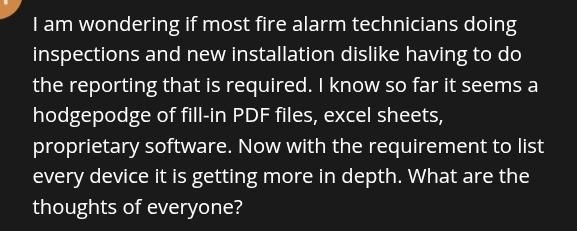
The conversation highlighted how many businesses still rely on a mixture of spreadsheets, PDFs, and separate reporting systems to document devices and inspection results.
Several technicians in the discussion noted that reporting requirements have become increasingly detailed because inspection records must accurately document devices, test results, deficiencies, corrective actions, and maintenance activities.
For alarm companies, the challenge is not simply completing the work itself.
The challenge is ensuring that the information generated during that work remains accurate, accessible, and organized afterward.
How AI Can Help Alarm System Businesses Manage Documentation More Efficiently
AI is often associated with advanced technology, but many of its most practical uses involve helping businesses organize and manage information more effectively.
For alarm companies, AI can help reduce the amount of repetitive administrative work required to support installations, inspections, and service operations.
AI Can Help Organize Inspection Reports
Inspection reports often contain large amounts of information, including device testing results, system deficiencies, maintenance recommendations, and customer notes.
AI-supported workflows can help structure inspection data more consistently and make historical records easier to search and retrieve when future service work is required.
AI Can Help Technicians Manage Field Notes
Technicians regularly record observations while working on alarm systems.
These notes may include equipment issues, customer requests, recommended repairs, system modifications, or follow-up actions.
Instead of manually transferring information between different systems, AI-supported tools can help organize technician notes and connect them to customer records more efficiently.
AI Can Improve Maintenance Tracking
Many alarm systems require recurring inspections, testing, and maintenance throughout their lifespan.
As customer portfolios grow, manually tracking service histories becomes increasingly difficult.
AI-supported systems can help organize maintenance records and make it easier to review previous inspections, identify recurring issues, and maintain complete service histories for each account.
AI Can Support Customer Communication
Alarm businesses frequently communicate with customers regarding inspections, service appointments, maintenance recommendations, testing schedules, and completed work.
AI-supported workflows can help organize those communications and ensure important information remains connected to the appropriate customer records.
[CTA_INSERT]
Why Is Information Management Becoming More Important in the Security Industry?
The security industry is becoming increasingly service-driven.
Customers expect quick responses, accurate records, and greater visibility into the systems protecting their properties.
At the same time, alarm companies are managing more information than they did twenty or thirty years ago.
A single customer account may generate installation records, inspection reports, maintenance logs, service histories, photographs, deficiency reports, and ongoing communications over many years.
When information is spread across emails, spreadsheets, PDFs, paper forms, and disconnected systems, finding what you need can become difficult.
The challenge is in keeping it organized in a way that allows technicians and office teams to access it when needed.
That is why many alarm companies are beginning to look for operational systems that support information management without adding unnecessary complexity to their workflows.
How Can Alarm System Companies Build Operational Systems Around the Way They Already Work?

Many alarm companies have developed their own methods for managing inspections, service visits, maintenance programs, and customer communication.
The problem is that not every business operates in the same way.
Some companies focus heavily on fire alarm inspections. Others specialize in intrusion systems, access control, monitoring services, or commercial security projects.
As a result, many businesses are looking for systems that can support the way they already operate instead of forcing them into rigid software structures.
For alarm companies that need more flexibility than a predefined system can offer, Dalton Mills gives teams a way to build operational tools around the way their work already gets done.
Dalton Mills is an AI platform that provides the operational foundation for alarm system companies to create workflows, tools, and processes around their existing operations.
Instead of requiring businesses to adapt to a predefined system, the platform allows teams to build around their own reporting requirements, maintenance processes, customer communication workflows, and service operations.
The goal is to help businesses spend less time managing information manually and more time focusing on the work that creates value for their customers.
If you want to explore how Dalton Mills can help alarm system companies build operational systems around real-world workflows, you can apply for early access today.
Build the tools your trade needs.
Dalton Mills gives people in the trades the opportunity to create custom workflows and software tools without any prior technical experience.
Apply For Early AccessRead next

How Much to Charge for Roofing Jobs in 2026
Industry data today shows that the average roofing business racks in a net profit of around 2.8%, which means around half of them are making less than that.
October 6, 2026

How Google Ads Work for Plumbing Businesses
Plumbers can and should use a variety of marketing strategies to increase their clientele and gain more market visibility.
October 5, 2026

How to Price Window Cleaning Services in 2026
A piece of industry data shows that around 64% of window cleaning services earn under $100K annually.
October 4, 2026