August 13, 2026
AI Customer Service Reps for Field Service Teams
A July 2026 study by Salesforce revealed that 95% of field service organizations have already incorporated some form of AI into their services. 85% of them also plan to expand upon that over the next 1-2 years.

A July 2026 study by Salesforce revealed that 95% of field service organizations have already incorporated some form of AI into their services. 85% of them also plan to expand upon that over the next 1-2 years.
According to the study, the primary goal of AI integration is customer satisfaction, followed by improved worker productivity and better safety outcomes.
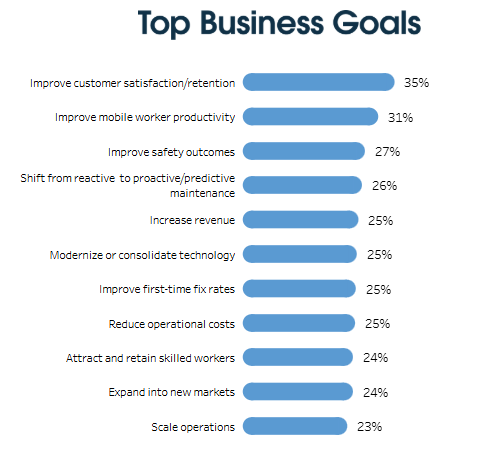
This explains why so many AI implementations have taken place in the customer relations department with AI Customer Service Reps (CSR) leading the way.
But what does AI CSR software do, how effective is it compared to human agents, and where does it fall short?
What AI CSR Does for Field Service Teams – The Good and the Bad
The AI CSR software simply replaces the human dispatcher at the front desk, taking calls, speaking to customers, over the phone or in writing, and taking actions accordingly (make appointments, forward the call to a human operator, etc.)
Most AI CSR systems operate via phone calls, web chats, and SMS, and are noticeably different from standard chatbots. Where chatbots would simply take in messages and only answer pre-recorded questions, AI CSR agents are capable of having more fluent conversations and making decisions based on the information they’re getting from the caller.
That being said, it would be unfair to qualify AI’s impact as overwhelmingly positive. So, here’s both the good and the bad.
[CTA_INSERT]
The Good
The implementation of AI CSR software aims to solve 3 distinct problems:
- Poor lead generation: Small and medium-sized businesses in particular tend to miss calls, especially during rush hours, which often costs them valuable leads. The AI agent doesn’t miss calls, directly contributing to higher lead generation.
- Fragmented availability: Human operators typically aren’t available during weekends and don’t function on a 24/7 basis. The AI is and does, which is very useful for addressing emergency calls, answering questions out-of-schedule, and, again, securing more leads.
- Not addressing complaints: This third point stems from the previous 2. Missing calls, whether due to rush hour congestion or being outside working hours, can cause complaints to turn into bad reviews. This directly impacts the business’s lead generation potential, since most potential clients rely on the customer review section to determine whether the provider is trustworthy.
On paper, these look like net positives, but AI, just like humans, isn’t perfect. It’s just more efficient, works faster, and doesn’t need naps. But it can still fail.
The Bad
AI’s main pitfall is, ironically, the human component of it. More clearly, it’s humans over-relying on AI and using it not as a tool, but as a substitute for human decision-making. In the field service sphere, this leads to problems like:
Communication misunderstandings: While AI can speak to the client more fluently, compared to a chatbot, it cannot reason. This leaves room for miscommunications, which can, for instance, cause the AI to flag a field issue as an emergency when it’s not. The team will then wrongly prioritize the job, while the client will face the higher emergency rates, instead of the standard ones. Even if the miscommunication is eventually solved, the company’s reputation can still suffer from a perceived lack of professionalism.
Poorly trained AI: An AI agent that’s insufficiently or poorly trained on the company’s internal ecosystem could make poor decisions that can break the consumer’s trust. The AI not tracking the scheduling board could, for instance, create conflicting appointments, causing confusion and service delays.
Bad AI implementation: Not all AI models are equally as capable or fit for a specific field trade. An AI agent that feels robotic and unrelatable, or one that shows communication issues (gets stuck in a loop or lacks coherence) can lead to bad reviews and poor lead generation and can even damage the business’s reputation.
These downsides don’t hint at AI CSR adoption being a bad idea. Instead, they suggest that correct implementation is paramount and that the AI is best used as a tool, rather than a replacement for genuine human skills.
How Customers Feel About AI CSR Software
While contractors tend to push for higher and better AI implementation, customers don’t share that enthusiasm. At least with regard to AI CSR systems.
In one particular case, a client complained about service companies using AI CSR agents that came with short-term memory, repeated questions and answers unprompted, not being able to track the conversation, and refusing to pass the call to a human operator.
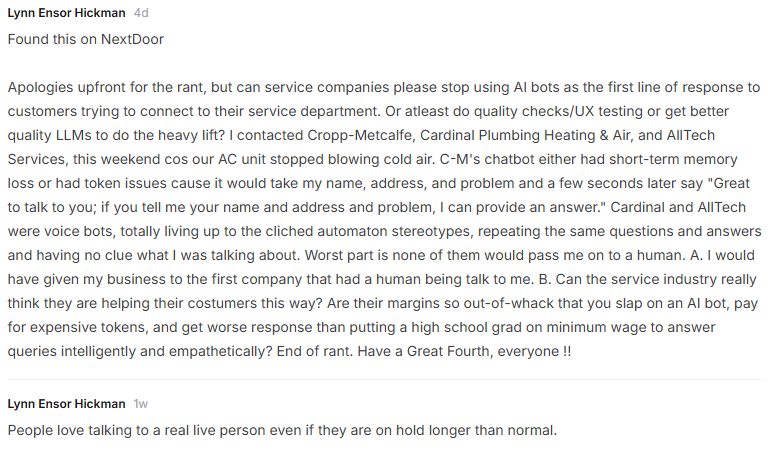
This isn’t a singular case, it’s a widespread problem within the industry. So much so that this client follows his rant up with “I would have given my business to the first company that had a human being talk to me.” And he’s not the only one in this position.
This case touches upon the “Bad AI Implementation” point we’ve discussed earlier and the fact that contractors used AI as replacement for the more competent and flexible human operators. The result is a bad experience for the customer and a lost lead for the business.
Fortunately, responsible implementation and tighter human oversight can solve this problem. One study highlighted exactly this after discovering that the AI customer support agent in a large call center increased overall productivity by 15%.
Some AI CSR systems are designed specifically for field-service trades, but even those have their own limitations, due to their supported integration lists.
If your business doesn't show on any of their supported partners, the platforms may not be configured for your specific use case.
So, what’s the better alternative?
The Rise of Custom AI CSR Software
The most glaring problem with industry-wide AI CSR systems is that they’re trained on the trades, not on each specific business, which is also reasonable. It’s virtually impossible to train the AI on every business model, operational structure, and unique internal data set in the world.
Which is too bad because that’s exactly what most businesses want, because all businesses operate differently, even those within the same trade. Each business faces its own challenges and has its own internal dataset that industry AI models, trained on averages, can’t always meet.
The solution is the custom AI CSR software.
Businesses can choose to create their own custom AI CSR tool to manage their customer support department and even devise AI field-service tools trained on their unique internal data.
A custom AI estimating tool that considers the company’s job history, an AI sales agent that automates the sales follow-up process, or an AI board that can offer different perspectives on managerial decisions – all these can be custom-made to fit your specific operational needs.
While industry-wide AI software is still the norm today, it’s understandable why so many contractors are starting to consider custom AI tools for their operations as more viable options. In 2026, this trend appears to be accelerating.
Build the tools your trade needs.
Dalton Mills gives people in the trades the opportunity to create custom workflows and software tools without any prior technical experience.
Apply For Early AccessRead next

How Much to Charge for Roofing Jobs in 2026
Industry data today shows that the average roofing business racks in a net profit of around 2.8%, which means around half of them are making less than that.
October 6, 2026

How Google Ads Work for Plumbing Businesses
Plumbers can and should use a variety of marketing strategies to increase their clientele and gain more market visibility.
October 5, 2026

How to Price Window Cleaning Services in 2026
A piece of industry data shows that around 64% of window cleaning services earn under $100K annually.
October 4, 2026