August 21, 2026
Why Gen Z is Quitting College to Work in the Trades
In 2026, 60% of Gen Z-ers plan to quit college and start working in the trades, with 21% of them aiming for constructions, 10% for electrical jobs, and 9% for manufacturing.

In 2026, 60% of Gen Z-ers plan to quit college and start working in the trades, with 21% of them aiming for constructions, 10% for electrical jobs, and 9% for manufacturing.
This trend is even more curious, considering that only 25% of them believed they would ever pursue a blue-collar career before graduating high school.
The first signs started to show in 2024, when the market saw a 16% increase in the number of students willing to pursue a blue-collar career. Moreover, it’s projected that the number will keep pumping up by 6.6% per year between 2025 and 2030.
Fast forward to 2026 and even parents support the trend. 52% of them believe that skilled trades offer a better ROI than white-collar jobs.
So, what’s driving this migration into the blue-collar sector?
Why Gen Z Are Looking for Blue-Collar Careers
27% of Gen Z-ers have invoked job security as the main reason behind their decision to pursue a blue-collar career, while 26% and 23% of them have mentioned skill fit and the higher earning potential respectively instead.
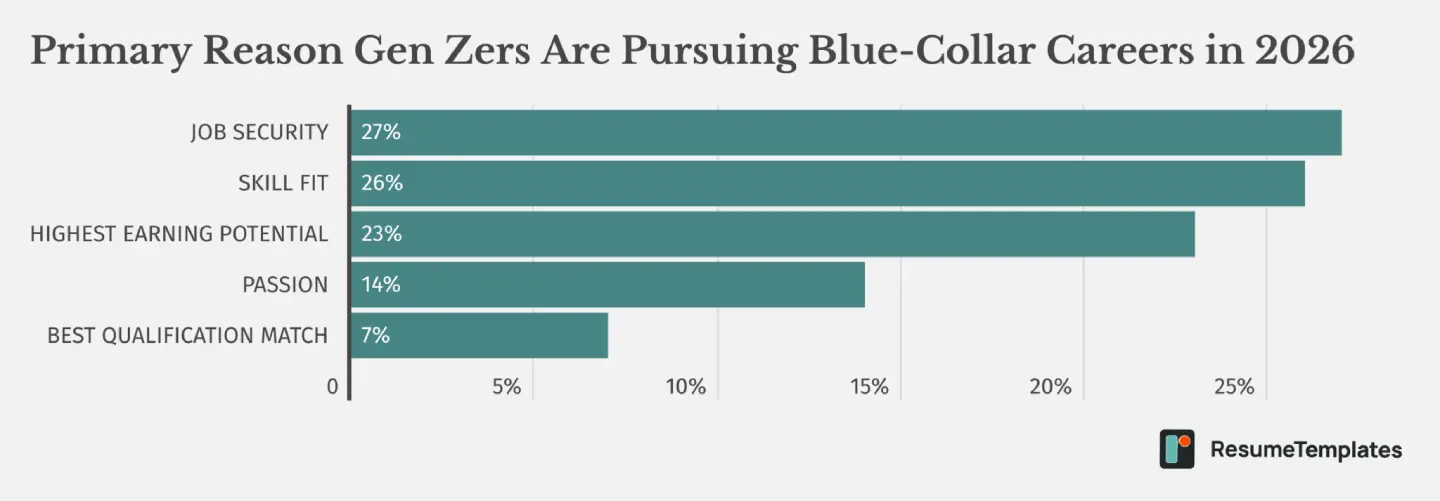
More importantly, 80% of those worried about job security say that they prefer the trades to corporate jobs because AI is less likely to take over their positions.
The rest of them have invoked other drives, like the higher pay for entry-level positions and personal passion. This adds to the fact that 58% of Gen Z students believe that college degrees are simply not worth the cost in 2026, which makes blue-collar careers even more appealing.
Especially in an era driven by AI innovation, which poses a direct risk to the job market.
Job Security in Blue-Collar vs. White-Collar Jobs in the AI Era
White-collar jobs have been the most affected by the rise of AI, compared to the blue-collar sector and the data is clear on it. 92,000 jobs gone in the US in February 2026-alone, following a grim 2025, when more than 1.1M layoffs were announced.
In most cases, the reason behind the layoffs remains the same “AI integration for increased efficiency and higher cost-effectiveness”. The most affected industries fall in the white-collar sector – technology and information, finance and insurance, accounting, marketing, office and administrative support, consulting, etc.
Even more cynical is the fact that, out of the 1,000 global executives surveyed in January 2026, 60% of them have cut jobs in anticipation of AI development. They’re willing to take the loss of human assistance in the hope that AI will eventually make up for it in the future.
Blue-collar jobs are more protected, with trades like construction and healthcare even facing workforce shortages, which AI can’t fill. That being said, not all trades are made equal – some are also facing automation threats, like manufacturing (45%) and automotive manufacturing (75%), but, fortunately, not due to AI.
This leaves Gen Z no choice but to re-orient themselves towards the blue-collar sector for a plus of job security.
The Best Blue-Collar Trades for Gen Z in 2026
The following are some of the best entry-level trades in terms of job security and earnings:
Naturally, the salary averages will vary depending on location, provider, and geographical positioning. US ranges will be typically higher than the EU ones.
Why Gen Z Should Become Entrepreneurs in 2026's AI Era
Industry data shows that 77% of Gen Z-ers wish to become business owners, with around 50% of them stating that the trades offer faster financial independence and stronger entrepreneurship opportunities.
Paradoxically, the main factor that makes blue-collar entrepreneurship easier in 2026 compared to previous years is AI. It’s all thanks to generative and predictive AI models finding their way into Field Service Management (FSM) and Customer Relationship Management (CRM) software, which are already capable of handling tasks like invoicing, scheduling, bookkeeping, and even lead conversion.
The addition of the AI offers more versatility to the field-service tools and CRM software that dominate the trades. This explains why 91% of small and medium-sized businesses (SBMs) report revenue boosts thanks to their AI integration.
Custom FSM and CRM tools are even more impactful for businesses that can’t find the value they seek in standard industry providers.
In one case, a handyman entrepreneur built an entire AI board of advisors to help him make better business decisions. This shows the value of custom-made FSM software, because standard tools aren’t tailored to each business in particular, they’re tailored to the trades in general.
More importantly, it’s easier than ever to create your own FSM and CRM tools today thanks to AI generative models that can do the coding for you.
How Dalton Mills Helps Gen Z-ers Grow Their Field Service Business
Dalton Mills is an AI-powered platform designed for the blue-collar entrepreneur who’s dissatisfied with what standard industry CRM and FSM providers have to offer.

The biggest problem with FSM tools today is that they’re not customized to any given business in particular. Not even AI integrations have managed to solve this problem. The underlying issue is that businesses operate in different market environments and have different operational and logistics problems.
An industry-wide software can’t account for all these differences.
Dalton Mills approaches this problem from a more practical perspective: rather than forcing a specific FSM tool on contractors, we help them build their own instead. This is great news for up-and-coming entrepreneurs who often face unique challenges that standard software models aren’t designed to address.
And because accessibility matters, you don’t need any coding or software engineering skills. Our AI model will handle everything on the backend side. All you need is the operational knowledge and the business goals to set things in motion.
You can apply for early access today if you want to test our system.
We also offer a vast set of free tools that can help you kickstart your business in any of the 36 trades that we cover.
FAQ
Should I skip college for a career in the trades?
Whether you should skip college for a career in the trades or not depends on your specific circumstances. Answering questions like “What trade should I join”, “Should I become an entrepreneur?”, and “What salary can I realistically earn based on my skills?” will give you a good idea on what you need to do.
As a general idea, 60% of Gen Z-ers consider quitting college for a job in the trades and 77% of them plan to become entrepreneurs.
Which blue-collar trade has the best job security in 2026?
Electricians, plumbers, and linemen are currently the most stable jobs with the highest job security thanks to their resistance to AI automation.
How much can I earn at a blue-collar job?
How much you can earn in a blue-collar job depends on the job itself and your qualifications and level of expertise. For instance, electricians, plumbers, and HVAC professionals earn between $30K and $40K annually on average.
Is it difficult to become an entrepreneur in the trades?
It can certainly be challenging to become a blue-collar entrepreneur if this is your first shot at it. Fortunately, modern-day FSM and CRM software, infused with AI-powered features, can help you manage your business operations and logistics a lot easier.
Build the tools your trade needs.
Dalton Mills gives people in the trades the opportunity to create custom workflows and software tools without any prior technical experience.
Apply For Early AccessRead next

How Much to Charge for Roofing Jobs in 2026
Industry data today shows that the average roofing business racks in a net profit of around 2.8%, which means around half of them are making less than that.
October 6, 2026

How Google Ads Work for Plumbing Businesses
Plumbers can and should use a variety of marketing strategies to increase their clientele and gain more market visibility.
October 5, 2026

How to Price Window Cleaning Services in 2026
A piece of industry data shows that around 64% of window cleaning services earn under $100K annually.
October 4, 2026