May 12, 2026
How AI Is Changing the Field Service Industry
AI is quietly reshaping how field service businesses run every part of their day.

A 2026 study by the Bureau of Economic Research showed that 71% of businesses, on average, were using at least one AI tech between November 2025 and January 2026, a 10% increase from the beginning of 2025.
According to the study, US executives foresee an AI-related productivity boost of 2.25% over the next three years, which explains why the US leads the AI adoption race with a 78% adoption rate.
As expected, the white-collar industry is at the forefront of the adoption wave and things aren’t slowing down. Mustafa Suleyman, Microsoft’s AI CEO, believes that AI could reach ‘human-level performance’ over the next 12 to 18 months, potentially replacing multiple white collar jobs, from accounting to lawyers and project managers.
The adoption trend is drastically lower in the blue-collar industry, but the devil is in the details. Compared to the white-collar ecosystem, where AI records accelerated evolution and tends to replace the workforce, blue-collar businesses use AI tools to help their workers instead.
The blue-collar ecosystem is more resistant to AI because of its very nature: we’re typically talking about brick-and-stone businesses with limited online presence and fewer digital needs.
Even so, AI tools can address critical problems that impact the overall workflow and the provider-customer relationship.
Before we address that, let’s first see what AI is, what AI tools are available, and then we’ll discuss how they can grow your business.
What is AI?
Simply put, Artificial Intelligence (AI) is a computer system designed to perform tasks that typically require human input. These include identifying and solving problems, informing or even making decisions, generating content (written, image, video, etc.), and recognizing patterns.
From a practical perspective, AI models are tools that you use to improve your workflow and productivity. 75% of those who use Chat GPT for instance, which is a Large Language Model (LLM), have reported saving 40 to 60 minutes per day thanks to GPT and that their work quality has improved.
The same trend is visible industry-wide and different AI tools have different impacts and applications.
LLMs

Large Language Models (LLMs) are some of the most popular tools today thanks to their versatility and rapid development.
LLMs like GPT, Gemini, and Claude target the writing and communication niches. These models are trained to recognize, generate, and understand human language, which makes them very versatile and useful across a variety of industries.These include IT, marketing, software development, education, and massmedia.
They also have niche specializations depending on the model.
For instance, GPT’s strong suit is programming and optimizing technical workflows, making it a great coding copilot. By comparison, Claude excels at large text analysis and output thanks to its adaptive thinking, which is why it’s especially useful in areas like legal, writing, researching, and, generally, large-document projects.
That said, all LLMs can perform the same tasks and, while some are better than others at specific tasks, the gap is closing fast as the AI race accelerates.
Other Types of AI Tools
Other types of AI tools include speech generation models, which can understand and generate human speech, generative AI machines like Midjourney and Seedance 2.0 for image and video production, and prediction AIs, which are particularly useful in industries like healthcare, banking, and crypto.
Generative AIs are also vital for industries like automotive, avionics, and even HVAC, thanks to their ability to predict and identify faulty equipment and processes.
Finally, we have AI agents, which have gradually become trustworthy assistants, with uses such as:
- AI coding agents: Write and debug code, perform tests, generate documentation.
- AI sales assistants: Analyze customer behavior, send and respond to emails, and qualify leads.
- AI scheduling assistants: Schedule and reschedule meetings, track calendar events, send reminders.
- AI customer support: Answer customer questions, escalate tickets, process refunds, troubleshoot issues.
- AI recruiting assistants: Interview candidates.
But how do AI tools integrate within the blue-collar industry and how can you use AI systems to boost your business’s operations?
[CTA_INSERT]
AI in the Blue-Collar Industry
Several issues are widespread within the blue-collar ecosystem, affecting multiple branches, like HVAC, plumbing, constructions, landscaping, roofing, and appliance repair and most of them typically fall into two distinct categories:
- Invoicing and Billing - This is a common pain point among small businesses specifically, which tend to wrestle with problems like invoice errors, administrative overload due to ramping document management, and being stuck to manual invoice writing.
- Customer Interaction - We’re talking about missed or late appointments, confusions, poor feedback management, ineffective email management, or convoluted service contracting, which could lead to lost clients, missed opportunities, and bad reviews.
When unaddressed, these issues can impact the business’s image and lead to revenue and client loss. A proficient AI tool can help massively in this sense by automating and optimizing processes that don’t require a human’s input as much.
AI Offers Novel Solutions to Old Problems
AI tools offer direct solutions to some of the oldest problems plaguing the blue-collar industry. For instance, a quick glance into the HVAC forums reveals that small businesses struggle with an array of issues.
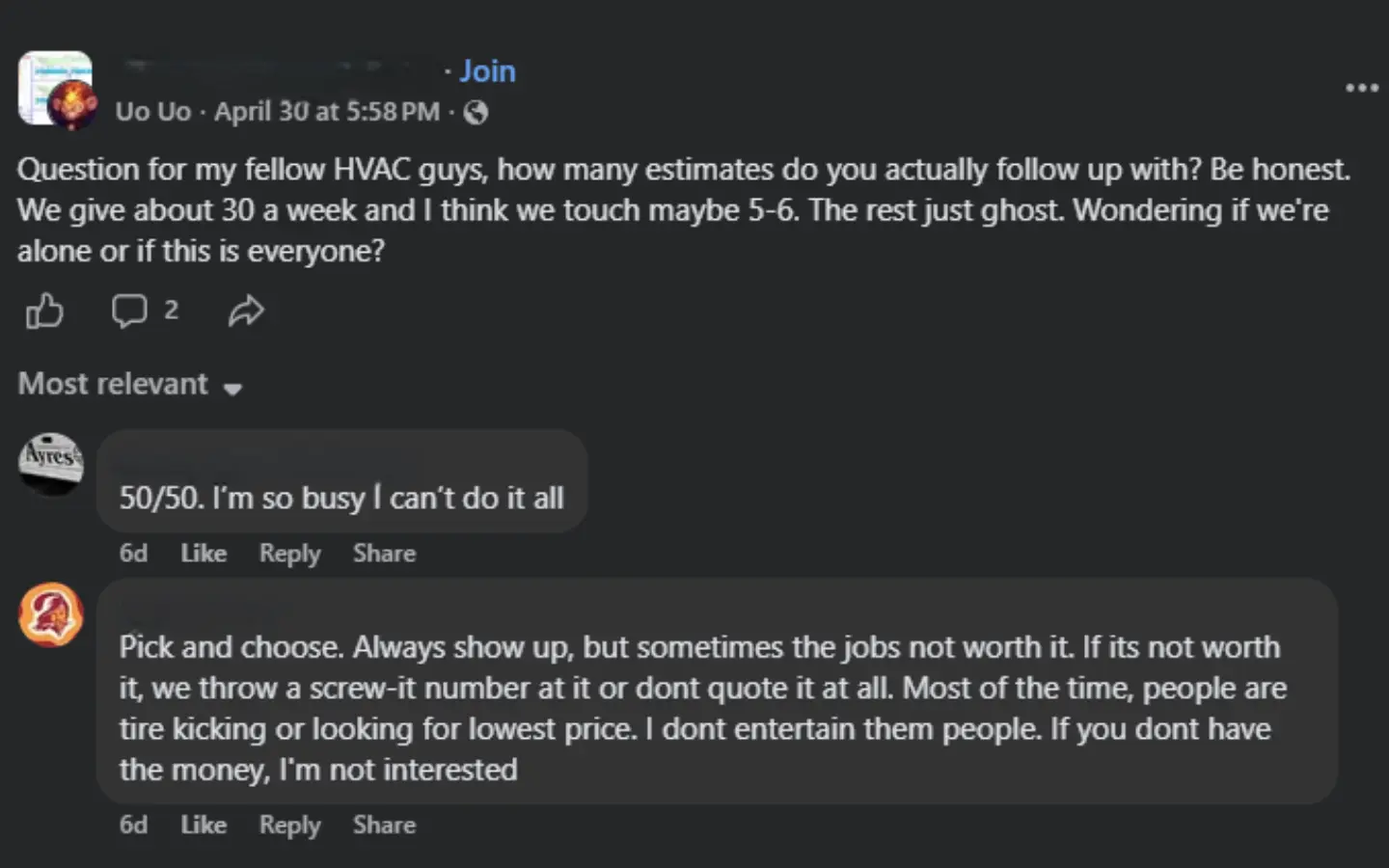
These problems could easily devolve into bad reviews, lost or messed-up orders, and, ultimately, lost clients and revenue dumps.
These issues are more prevalent among small HVAC businesses, which struggle to optimize their workflow due to a manpower shortage; typical for an emerging business trying to build its reputation and grow its client database. It’s where most businesses either keep swimming or drown.
A good AI software can solve most of these problems by automating everything that doesn’t require a human’s input or that only requires minimal human oversight, like:
- Respond to emails
- Send follow-up email responses
- Take in calls and appointments
- Send confirmations and estimates
- Set reminders
- Auto-fill invoices
- Manage CRM updates
However, HVAC businesses often have different goals and needs, despite sharing the same industry profile. This means that one-size-fits-all platforms are unlikely to hit the sweet spot, when compared to a customizable software.
Build Your Own Field Service Platform with Dalton Mills
Targeting the blue-collar industry specifically, Dalton Mills is an AI-powered software that relies on a simple idea: only you know what your business needs in terms of workflow, day-to-day operations, customer relationship, and your overall service model.

The Dalton Mills platform allows you, among others, to automate your invoicing process, keep track of orders, refunds, and client questions, and record your operational details to keep things simple and structured.
This is great for small and medium-sized businesses which seek to decongest and optimize their workflow and improve their brand visibility.
If you have the field knowledge, Dalton Mills gives you the AI platform to build on it. Apply for early access today.
Build the tools your trade needs.
Dalton Mills gives people in the trades the opportunity to create custom workflows and software tools without any prior technical experience.
Apply For Early AccessRead next

How Much to Charge for Roofing Jobs in 2026
Industry data today shows that the average roofing business racks in a net profit of around 2.8%, which means around half of them are making less than that.
October 6, 2026

How Google Ads Work for Plumbing Businesses
Plumbers can and should use a variety of marketing strategies to increase their clientele and gain more market visibility.
October 5, 2026

How to Price Window Cleaning Services in 2026
A piece of industry data shows that around 64% of window cleaning services earn under $100K annually.
October 4, 2026