August 12, 2026
Painting Costs & Pricing in 2026: How to Structure Your Rates
Pricing your painting services based on the competition is a losing move because not all businesses and contractors have the same expenses.
Pricing your painting services based on the competition is a losing move because not all businesses and contractors have the same expenses. While competition rates matter, because they define the market’s direction, they come second to your operational costs.
Today, we’ll discuss what the painting rates are in 2026, how to price your painting services correctly, and which pricing model could work best for your business model.
Pricing Models and Service Rates for Painting Work in 2026
The following tables highlight price differences between the various pricing models (Table 1) and between painting jobs by square footage and commercial vs. residential separation.
Table 1:
The per-square-foot pricing model is the standard for both residential and commercial pricebooks, but other models also apply. Hourly rates, for instance, are better suited for jobs with unpredictable scopes, while flat rates per room are more fitting for residences with a lot of rooms.
Table 2:
Important notes:
Residential rates often go higher than commercial ones for interior work, which is rather atypical when compared to other blue-collar trades like plumbing, electrical, roofing, or landscaping.
That’s because residential painting work often requires frequent color changes and working around multiple corners. Commercial buildings have larger and more uniform areas, making jobs easier and cheaper on average.
Commercial rates, however, are higher for exterior work due to reasons like higher heights and stricter coating requirements.
In both cases, the rate difference will fluctuate between 20% and 30%, give or take, depending on the market and the contractual agreement.
The Best Pricing Model for Painting Jobs
The best pricing model is simply the one that gives you the most profit for the work invested. In painting work, that’s the $/sq ft model, for both residential and commercial jobs.
The per sq ft model works the best for residential jobs because homes are easily breakable into surface areas, making the job predictable and safe profit-wise. A 2000-square-foot home is easy to quote over the phone, giving the client a clear and easy-to-digest estimate.
The sq ft pay also scales predictably, allowing contractors to easily incorporate any scope creeping into the final bill. One more room that wasn’t in the initial agreement? Turn it into its sq ft equivalent and add it to the pay.
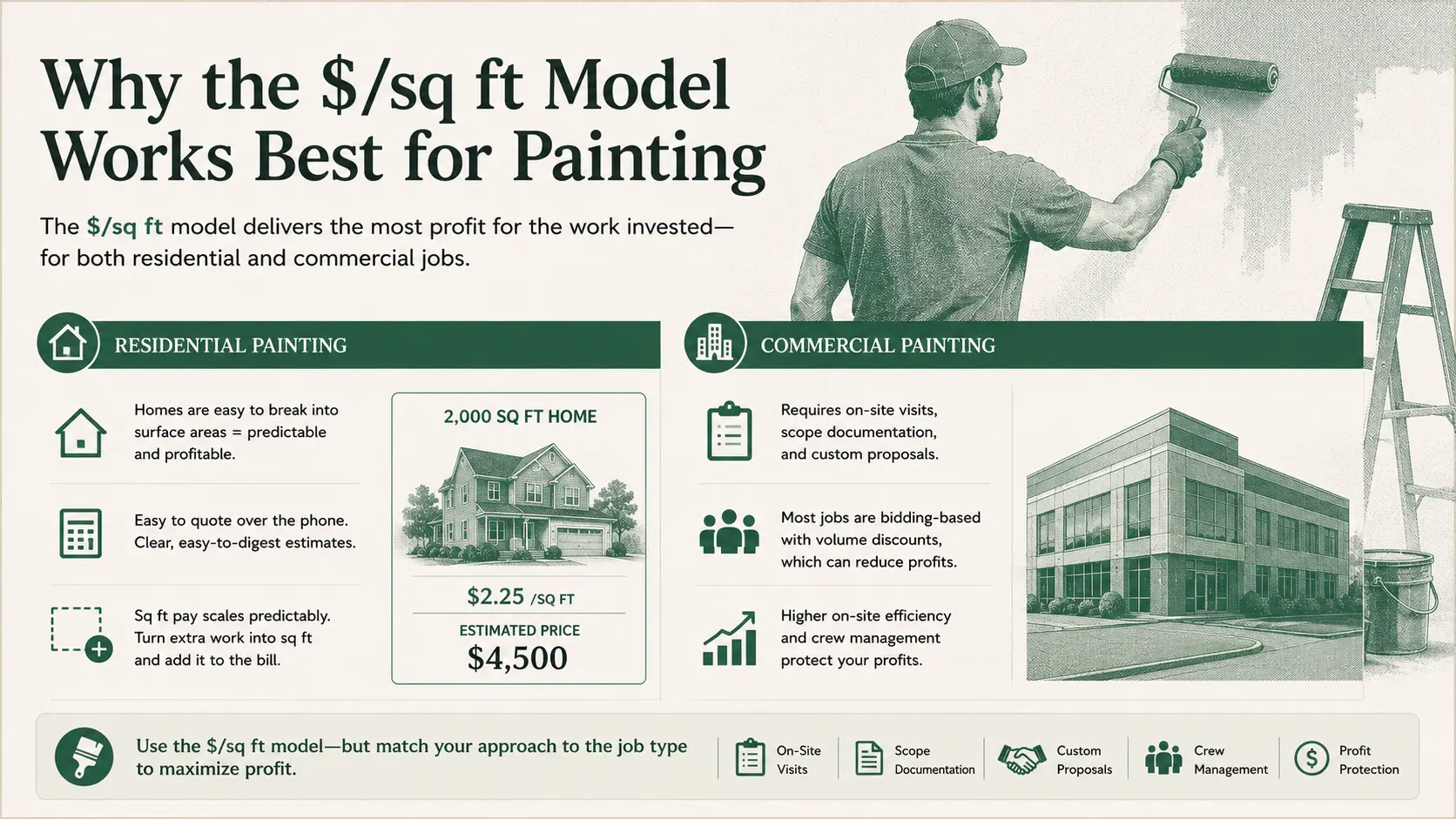
Commercial jobs function similarly with just one caveat: the bidding system. Unlike residential jobs, commercial contracts don’t work on a quote-by-phone basis. Instead, property managers and facility owners expect on-site visits, clear scope documentation, and a custom proposal.
Most commercial painting work is also bidding-based. Pair this with the unwritten policy of volume-based discounts and the profit may suffer. As a result, painting contractors need to more carefully manage their crews to ensure higher on-site efficiency to recuperate costs.
While still using the $/sq ft model, commercial jobs have additional aspects worth considering.
How to Build Profit Into Your Painting Jobs
The profit needs to be mathematically defined and baked into the pricebook itself, the same as the costs. Most contractors go for net profit margins of 10-25%, with the 20-25% range being optimal for a well-run, healthy business.
The problem is that business costs can sometimes eat into the profit slice if not accounted for correctly.
With that in mind, here’s what the painting rate needs to cover to ensure that profit threshold:
- Labor costs: This includes the painter’s wage, along with the loaded costs (payroll taxes, liability insurance, workers’ comp, and any other benefits).
- Material markups: Markups are costs added to the material’s price, including shipping or pickup expenses and price raises over time (you should price your last-year’s paint at today’s costs). Markup costs are often overlooked by contractors.
- Overhead expenses: Every fixed cost associated with running your business goes here. Rent, vehicle maintenance and fuel costs, admin work, marketing, insurance premiums, etc.
Once everything is covered, you then add the 20-25% profit margin on top of it and that’s your quote.
[CTA_INSERT]
Example:
Painting a 2,000 sq ft home, walls only, standard drywall in good condition, requiring two coats on a 2-man crew.
Step 1: Labor (loaded, not wage)
- Painter wage: $25/hr per painter
- Labor burden (payroll taxes, workers' comp, liability insurance): ~32%
- Loaded labor rate: $33/hr per painter
- Estimated time: 20 hours per painter × 2 painters = 40 total labor hours
Labor cost = 40 hrs × $33/hr = $1,320
Step 2: Materials (replacement cost)
- Paint: 2,000 sq ft × 2 coats ÷ 350 sq ft/gallon coverage ≈ 12 gallons × $30/gal = $360
- Primer (spot priming only): 2 gallons × $20 = $40
- Sundries – tape, plastic sheeting, rollers, brushes: $120
Materials cost = $520
Step 3: Overhead allocation
- Annual fixed overhead (vehicle, insurance, software, marketing, admin time): $42,000/year
- Estimated annual billable crew hours: 1,400 hours
- Overhead rate: $42,000 ÷ 1,400 = $30/hr
Overhead cost = 40 hrs × $30/hr = $1,200
The math takes us to $3,040 as total costs, to which we add the 20% net profit margin for a final quote of $3,800. This takes your net profit to $760 for this particular job.
This translates to a $1.90/sq ft job, which falls on the lower end of the standard $1-$6/sq ft quote for residential work that we mentioned in Table 1. The $1.90 quote is fair in this particular case due to only doing the walls.
The Most Common Pricing Mistakes for Painting Jobs
Choosing the wrong pricing model
No pricing model is wrong in the true sense of the word, but some pricing models work better than others in specific scenarios. For instance, going for the $/sq ft model for a home with the walls in poor condition may increase the time necessary to complete the task. In that particular case, an hourly rate may be more fitting.
Ignoring overhead costs
Overhead costs are easy to ignore because they come from different business avenues, causing many contractors to overlook them. But the importance of overhead costs goes beyond the ‘accounting for all costs’ reasoning. Each job’s overhead costs tell a story about that job’s profitability, which makes them that much more important.
Pricing services based on competition
You should always price your painting services based on the factors we’ve already mentioned (loaded wage costs, overhead expenses, etc.), not based on competition rates. That’s because every business has its own operational logistics, costs, and profitability goals. What your competition does matters, but less so compared to your internal costs. "Internal costs are a driving factor, especially when it comes to materials and labor. These costs can vary significantly by city, state, and even ZIP code,” says Carr the CEO of Improovy, a Chicago based house painting company.
FAQ
How much should I charge per square foot for painting jobs?
Most residential jobs go for $1-$6/sq ft, but painting rates depend on multiple variables, including your operational costs, the market, and on-site conditions.
What pricing model to use for painting jobs?
The most common pricing model for painting jobs is $/sq ft. That’s because it’s easy to quote and predictable from a revenue standpoint. However, not all jobs are fit for the per square foot model. In many cases, you may need to charge an hourly rate (including material prices) or offer quotes per day or per room.
When to increase rates for painting jobs?
You should consider increasing your rates for your painting jobs at least once per year to account for increases in material costs, higher fuel expenses and rent, and inflation.
What profit margin can I get for painting jobs?
Try to target a net profit margin of 15-25%. Lower than 10% is usually bad business, while higher than 25-30% may be unsustainable, especially if you have a lot of local competition.
Build the tools your trade needs.
Dalton Mills gives people in the trades the opportunity to create custom workflows and software tools without any prior technical experience.
Apply For Early AccessRead next

How Much to Charge for Roofing Jobs in 2026
Industry data today shows that the average roofing business racks in a net profit of around 2.8%, which means around half of them are making less than that.
October 6, 2026
How Google Ads Work for Plumbing Businesses
Plumbers can and should use a variety of marketing strategies to increase their clientele and gain more market visibility.
October 5, 2026

How to Price Window Cleaning Services in 2026
A piece of industry data shows that around 64% of window cleaning services earn under $100K annually.
October 4, 2026