July 11, 2026
How AI Solves Scope Creeping in Janitorial Jobs
Scope creeping is one of the most prevalent problems in the janitorial trade.

Scope creeping is one of the most prevalent problems in the janitorial trade. It’s common for clients to ask for extra work on top of what was already agreed upon, which can quickly increase job costs.
In many cases, technicians agree to the on-site demands because the agreement itself isn’t clear. In other cases, it’s because they don’t want to lose the client.

Whatever the reasoning may be, doing work outside of the initial agreement causes costs to pile up. Using a good estimating software can mitigate the problem by creating more comprehensive job estimates that the client can accept before the project.
The problem is that standard estimating tools still require manual input, so it’s the operator who has to record the tasks manually.
AI can drastically simplify that job.
Why AI is Better Than Traditional Software for Solving Scope Creeping
The most glaring weakness of standard estimating tools and scheduling software is that they function based on human input. In other words, they’re good at organizing the data that humans have already defined. This is true no matter the type of software or the trade they’re adapted for, whether it’s appliance repair, fencing, restoration, or construction.
AI goes one beyond that, taking over some of the human tasks and speeding up the estimating process. An AI-powered software can:
- Recommend the cleaning procedures typical with commercial or residential sites (in the case of full-service projects)
- Flag out-of-project requests as potential scope changes
- Offer clients a comprehensive task and cost list to eliminate surprises
- Adjusts the project cost for cases where extra services are added on the spot
A custom AI-powered software can also record out-of-project requests and build a database for later use. Contractors can use that information to update their service contracts and pricing accordingly.
This makes AI more flexible and more adept at preventing scope creeping than traditional software. Most importantly, it works for any trade with extensive service spreadsheets, like handyman jobs, property maintenance, and restoration work.
[CTA_INSERT]
How to Use AI to Deal with Scope Creeping in Janitorial Jobs
Janitorial jobs typically involve a wide range of services, including window cleaning, carpet vacuuming and shampooing, dusting, disinfecting, trash removal, waxing, and polishing. The task spreadsheet can get quite large, making it difficult to manage manually.
A custom AI software, built specifically for janitorial services, can solve a lot of problems.
For instance, the technician can immediately verify if a task request is already written in the contract or not. Now, imagine a custom-made app that takes voice requests or questions, which the technician can use to check exactly that. If the task isn’t in the spreadsheet, the technician can add it there on the spot and immediately get a price quote for the extra work.
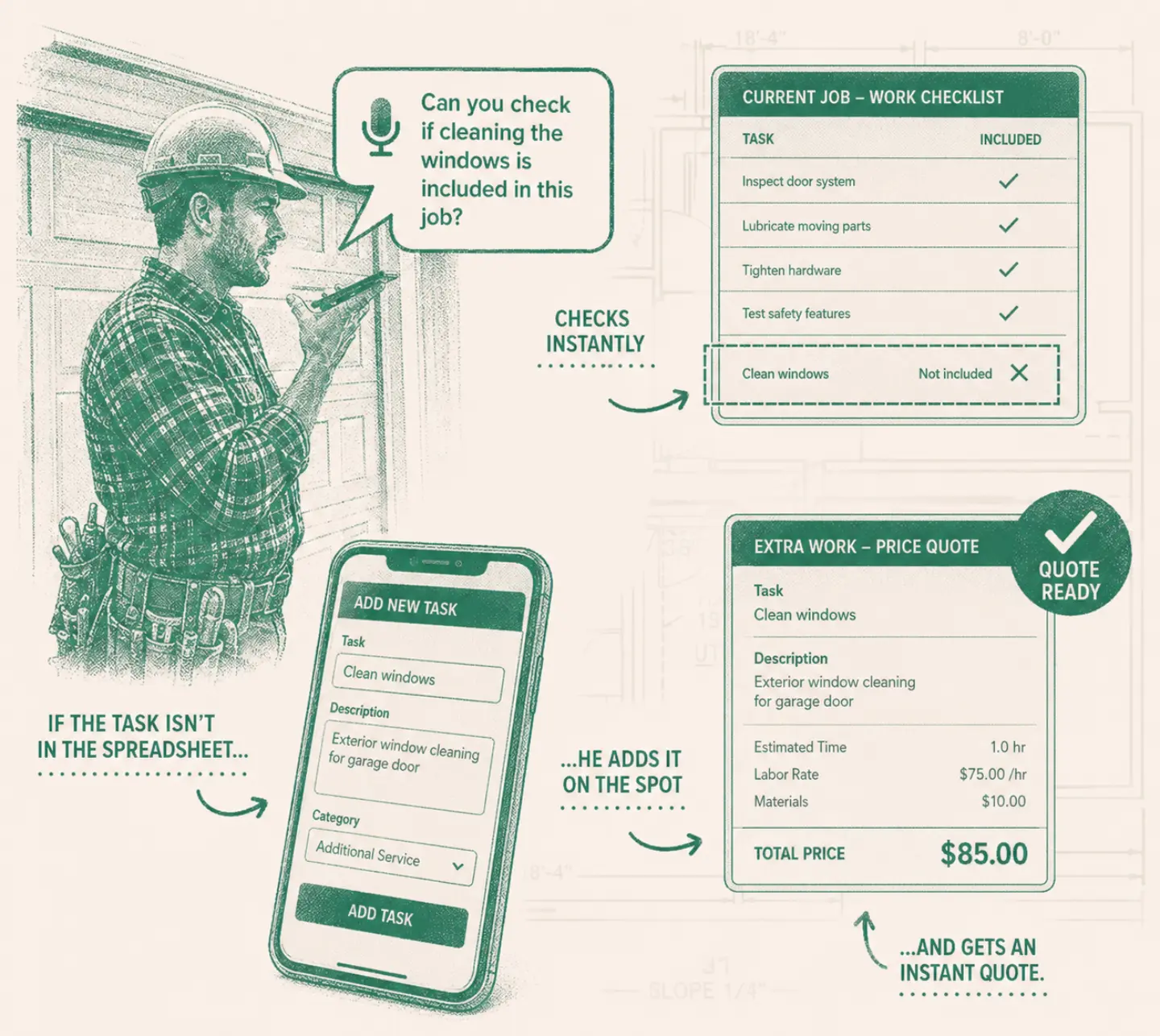
This type of system would put an end to the “small favor” trend, which can cost technicians time and extra work, while contractors lose money in the process.
Standard CRM or field service software don’t have this type of adaptability. They’re not made for businesses and their unique hurdles, but for trades in general.
AI is superior because contractors can use it to create any piece of software they need to address problems that may be unique to their company. A software specialized in sales training, a voice-quoting app, or even something more creative like an AI board of advisors to inform operational decisions, everything is doable.
How Dalton Mills Succeeds Where Classic Field Service Software Fails
Dalton Mills is an AI-powered platform designed specifically for the blue-collar industry. The concept behind it is to offer a solution to the biggest problem that CRM and field service tools can’t solve: lack of customizability.
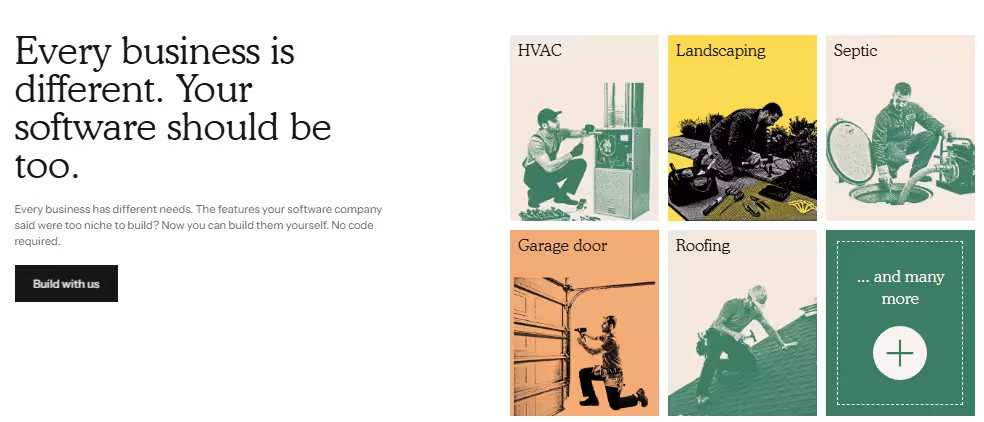
We see it time and time again: contractors who are forced to adapt their operations to make them fit the software they’re using. Or using several pieces of software to juggle multiple services, like the case of one professional restorator who was using 11 software tools, before replacing everything with AI.
With Dalton Mills, contractors can now use AI to create the exact piece of software they need, tailored to their services specifically and there’s no requirement for coding knowledge or experience in software engineering. The AI handles everything in that department.
If your standard software can’t help you solve the scope creeping problem or have operational hurdles that your field service tools can’t fix, give Dalton Mills a try. We’re in early access right now, so apply for a spot on our official website today.
Build the tools your trade needs.
Dalton Mills gives people in the trades the opportunity to create custom workflows and software tools without any prior technical experience.
Apply For Early AccessRead next

How Much to Charge for Roofing Jobs in 2026
Industry data today shows that the average roofing business racks in a net profit of around 2.8%, which means around half of them are making less than that.
October 6, 2026

How Google Ads Work for Plumbing Businesses
Plumbers can and should use a variety of marketing strategies to increase their clientele and gain more market visibility.
October 5, 2026

How to Price Window Cleaning Services in 2026
A piece of industry data shows that around 64% of window cleaning services earn under $100K annually.
October 4, 2026