August 16, 2026
How to Filter Out Spam Calls as a Field Service Businesses
While businesses are typically flooded by spam emails, spam calls are equally as damaging and disruptive.

While businesses are typically flooded by spam emails, spam calls are equally as damaging and disruptive.
The US alone has recorded over 2.56B robocalls in 2025, up from 2.14 in 2024 and this isn’t a US problem-only.
Globally, the situation is far worse, with the number of spam calls identified in 2025 jumping to over 68B. Telemarketing and scam calls make up the bulk of it (58%) and are notoriously difficult to combat.
Perpetrators rotate phone numbers constantly, redirect their operations through global networks, and even exploit the VoIP infrastructure to evade enforcement efforts.
Today, we’ll discuss how spam calls impact field service businesses and how to filter them out for good.
Why Spam Calls are More Disruptive to Field Service Businesses
Unlike desk jobs, field service businesses can’t afford not to take calls due to the urgent nature of some of them. Trades like plumbing, roofing, electrical, or HVAC often take in emergency calls that require immediate intervention. This makes field service companies particularly vulnerable to spam and scam calls.
The most glaring downside of having to deal with spam calls as a field service business is the higher junk call volume causing operators to miss legitimate leads.
This is especially a problem for small and medium-sized field service companies with moderate resources. These businesses don’t have enough call operators to keep their lines clear for customers, while also handling spam calls.
Fortunately, there are ways to fix the problem.
How Field Service Businesses Can Filter Out Spam Calls
The challenge, when filtering out spam calls, is to make sure the process doesn’t bother real customers too much. Call screenings are necessary, especially when dealing with a large volume of spam calls, but there comes a point when they become a liability if they have too many layers.
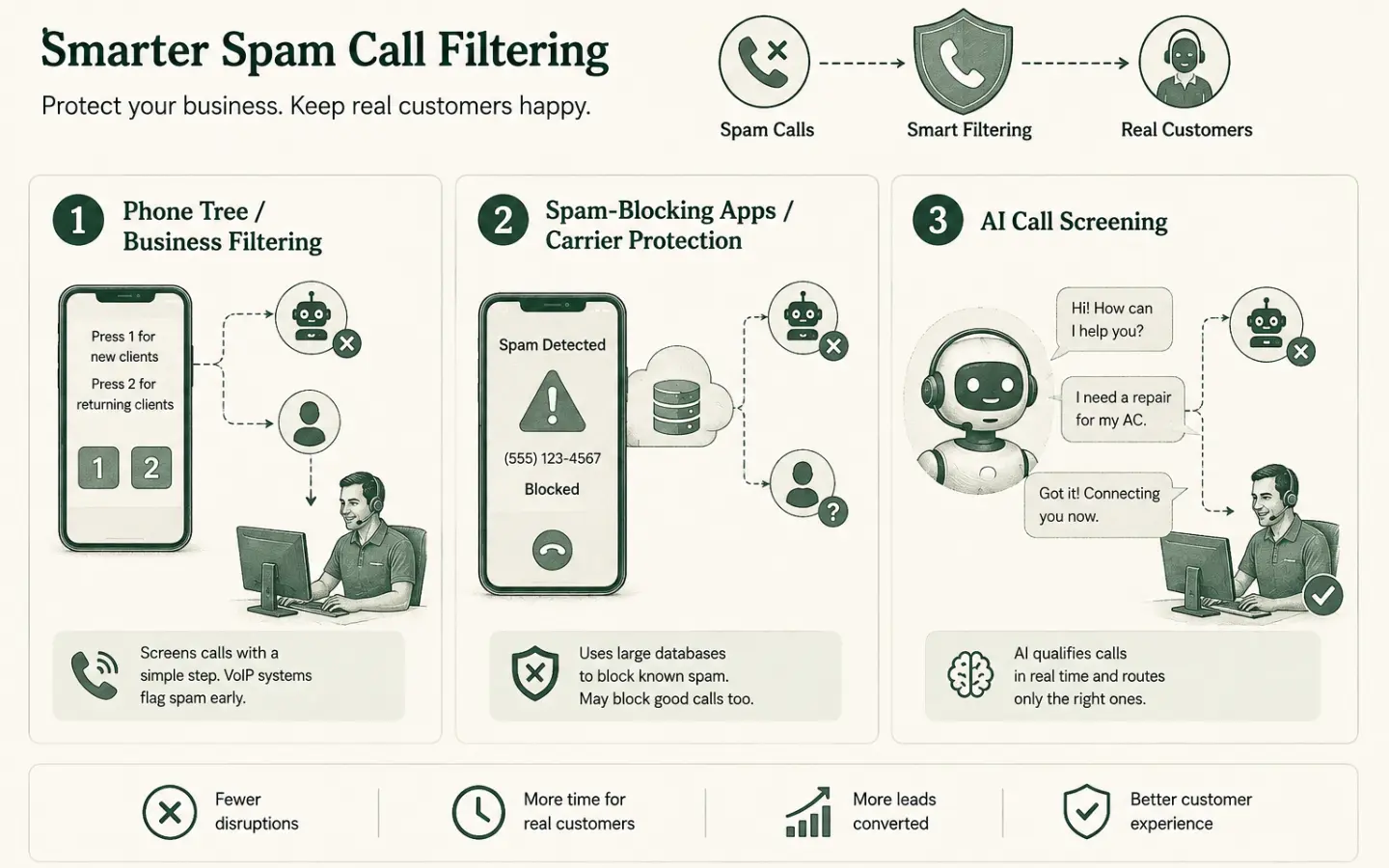
With that in mind, here are the most effective ways to filter out spam calls as a field service business:
A Business Phone Filtering System / Phone Tree
A phone tree filtering system typically adds another intermediary step between the customer and the human operator. Something like “Press 1 if you’re a new client or 2 if you’re a returning one” is pretty effective at combating robocalls, since automated programs can’t get past that line of salt.
VoIP platforms also integrate spam detection into the call system to flag calls that meet the spamming prerequisites.
Spam-Blocking Apps / Carrier Protection
Consumer-grade spam-blocking apps are also a decent alternative, particularly thanks to their access to a vast database of users. The apps can scan through millions of phone numbers, flagging and shadow-blocking high-volume spam IDs.
Unfortunately, these types of apps are fully indiscriminate, which means they cannot distinguish between an unfamiliar spam number and a potential customer. This makes spam-blocking apps more fitting for individuals or, at most, small businesses with a low clientele.
AI Call Screening
In 2026, AI customer service reps are slowly becoming the norm when it comes to CRM thanks to the extra utility. The differentiating factor between an AI assistant and a standard spam-blocking app is that the AI can qualify calls.
The agent can ask questions, make a judgment in real time, and decide where the call goes; spam calls go nowhere, while legitimate ones will reach the human operator. This system filters out spam and scam calls, without impacting real emergencies and genuine leads.
Important Note:
Call blocking apps are not install-and-forget features; they need periodical checking and updating. Various spam tactics like caller ID spoofing, SIM-farm calls, or evolving robocall patterns could cause the filter to misfire. You need to check it periodically to make sure it keeps blocking flagged calls, while allowing legitimate ones through.
[CTA_INSERT]
How to Protect Your Field Service Business Number from Being Flagged as Spam
No legitimate field service business expects their business number to be flagged as spam for customers. Yet, that can happen and you wouldn’t know it.
The reason lies in how spam-blocking software works. Instead of blacklisting known scamming or spamming numbers, carrier spam-detection apps analyze call behavior in real time. Features like a high number of call outputs in a short window, many short-duration calls, or dials spread across a large geographical area can trigger the system.
Yet, these could just be part of your normal operational activity – calling customers for appointments, reschedules, job confirmations, reminders, etc. Even contacting your own crew from your business line can add up to the mix.
Worst-case scenario, your number gets filtered out by the spam-detection apps. Best-case scenario – calls will get the “Likely Spam” tag, making customers distrust your line and blacklist it themselves.
To prevent that, here are some things you can do:
Register and verify the business number – Registering your number with your local branded-calling services enables the Caller-ID feature. This means that whenever you call someone, your business name will be displayed, instead of the phone number. This immediately increases customer trust.
Space out outbound calls – Spread out your business calls (reminders, confirmations, lead hunting, etc.) over a larger time window to fly under the radar of carrier detection systems.
Update your call list regularly – Some phone numbers get discontinued or reassigned, causing you to lose precious time and increasing your outbound call volume for nothing. Updating your call list regularly (2-3 times per year) can prevent that.
Have Plan B ready – If your number does get flagged, you can contact the respective spam database services to have the spam label removed. It’s a pretty straightforward process, but it’s worth having it ready-to-go, rather than scrambling to figure it out when you need it.
These strategies are worth looking-into, considering that businesses are more likely to have their phone numbers flagged as spam, compared to regular individuals.
Build the tools your trade needs.
Dalton Mills gives people in the trades the opportunity to create custom workflows and software tools without any prior technical experience.
Apply For Early AccessRead next

How Much to Charge for Roofing Jobs in 2026
Industry data today shows that the average roofing business racks in a net profit of around 2.8%, which means around half of them are making less than that.
October 6, 2026
How Google Ads Work for Plumbing Businesses
Plumbers can and should use a variety of marketing strategies to increase their clientele and gain more market visibility.
October 5, 2026

How to Price Window Cleaning Services in 2026
A piece of industry data shows that around 64% of window cleaning services earn under $100K annually.
October 4, 2026