September 18, 2026
How to Do SEO for HVAC Businesses in 2026
When it comes to business growth, few channels have a more visible impact than SEO. HVAC businesses have multiple ways to expand and improve, including through paid ads, cashflow optimization, and AI automation.

Key Takeaways:
- HVAC businesses doing good SEO showcase a median ROI of 27.46X
- An optimized SEO strategy will help HVAC businesses get cited by AI models more often
- SEO can cost HVAC businesses between $1,500 and $5,000+ per month, depending on resources and scope
- SEO requires ongoing tracking and management to remain effective
When it comes to business growth, few channels have a more visible impact than SEO. HVAC businesses have multiple ways to expand and improve, including through paid ads, cashflow optimization, and AI automation.
SEO, however, hits differently, because it targets long-term organic growth. A 2025 study showed that HVAC businesses investing in SEO show a median ROI of 27.46X compared to those that don’t. That’s because organic searches accounted for almost half of booked and paying customers.
But SEO only has a meaningful positive impact when done correctly.
How HVAC Businesses Should Do SEO in 2026
A good SEO strategy should cover several areas:
Local SEO
Local SEO is your starting point and the most impactful for Small and Medium-Sized Businesses (SMBs) and it includes:
Google Business Profile: All your subsequent HVAC marketing strategies depend on having a complete Google Business Profile, which should contain your business’s name, address, and phone number (NAP) as a starting point. You also need to mention your service area, working hours, contact info (email, social media accounts), any relevant photos (team, trucks, recent jobs, etc.), and a full list of services.
Local Keyword Ranking: Target local keywords like “HVAC services near me” or “HVAC businesses in Colorado” when doing blogs and social media posts. This signals Google to prioritize your business to clients looking for local HVAC services.
List your HVAC business in online directories: Target the most popular directories like Yelp, NextDoor, Better Business Bureau (BBB), and Facebook Business Page. These increase your visibility by exposing you to clients looking for qualified HVAC professionals from more reputable sources.
Local SEO is your first and most important SEO strategy and getting it right the first time can boost your business’s online impact fast.
[CTA_INSERT]
On-Page SEO
On-page SEO addresses several strategies that ultimately work together to solidify your online presence:
Create a blog: Have an informative blog covering everything from DIYs to HVAC services and problems people may face with their HVAC units. This adds value to the reader, which instructs Google to see your content as legitimate and helpful – a quick way to rank to the top of the Search Engine Results Page (SERPs).
Optimize keywords and metadata: Optimize your blog content for local and emergency-related keywords (“urgent HVAC repairs near me”, “urgent air conditioning services”, etc.) Also optimize the metadata (meta descriptions, URL, meta title), because these inform Google of your content’s intent.
Structure the content properly: Use the right header structure (H1 for titles, H2 for the primary sections, H3 for subsections under H2s, etc.) and have different pages for different services. Google likes this cleaner and easier-to-navigate structure.
Optimize your website for mobile: Most people looking for local HVAC services conduct their searches on mobile devices. This means you need to optimize your website for mobile and smart devices by compressing images, upgrading your hosting, and testing your website with something like Google’s PageSpeed Insights. The faster the website, the higher the chances that the visitor will convert to a lead.
On-Page SEO will likely take up the most resources, but will be the most impactful in the long run.
Off-Page SEO
Off-page SEO includes:
Backlinking: A backlink is a link posted by a third-party website that leads to your website. You can build backlinks by asking your partners (suppliers, subcontractors, local contractors in related trades like home remodeling and constructions) to link to your services. Joining HVAC associations and group forums can also help with that.
Build your social media presence: Create social media accounts on the largest social media hubs like LinkedIn, NextDoor, Facebook, and Instagram, and start writing informative posts to increase your online visibility. HVAC tips, behind-the-scenes snippets, one-the-job photos and videos, and before-and-after stills can get you the engagement and exposure you need.
Manage customer reviews professionally: You should monitor and answer all reviews, whether negative or positive, but especially the negative ones. A professional and helpful response to a negative review can increase your market stock and customer trust.
Build cross-trade partnerships: This could be the most impactful off-page SEO strategy, because it exposes your business to a larger database of potential clients that may need HVAC services in the future. Contact local roofers, construction contractors, real estate agents, and property managers to offer mutual service promotion for mutual benefits.
Off-page SEO is often ignored by many HVAC professionals, because it requires a lot of micro-management, but its impact on a business’s growth and market visibility cannot be overstated.
Technical SEO
Submit your XML sitemap for easier search engine indexing, upgrade to the HTTPS encryption for a plus of security, and make sure your NAP data is consistent across all sources. Good technical SEO will increase your business’s trust factor with Google, which will lead to increased visibility.
You should also make sure your business is consistently cited by AI, especially at the top of the search engine page.
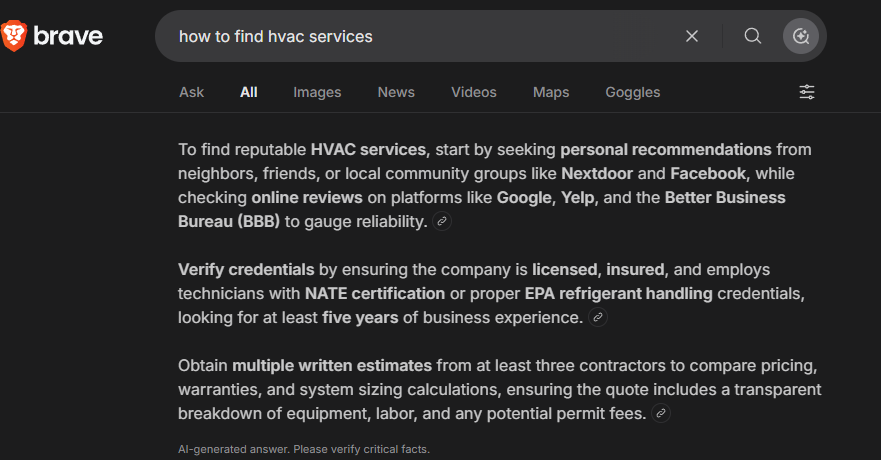
Users rely on AI to find local services and general information about different subjects at a considerably higher rate compared to several years ago. Plus, around 45% of consumers use AI for local service recommendations and 68% of local queries will display an AI overview at the top of the page.
The good news is that you don’t need to do anything special to increase your good-standing with AI. So long as your overall SEO strategy is clean, AI will eventually highlight your business.
When done correctly, SEO is vastly more effective than Google Ads for HVAC businesses looking for long-term market growth.
How Much Does SEO Cost for HVAC?
SEO has different pricing tiers, depending on your business’s size, scope, and funds:
$1,500-$2,500/month – Basic tier, covering businesses in low-competition areas that can get away with a more modest SEO strategy. Even better if you can do some of the SEO work yourself to cut down costs.
$2,500-$3,500/month – A good price range for established businesses with a dedicated SEO fund and in full expansion mode.
$3,500-$5,000+/month – A price tier more fitting for multi-location HVAC businesses or those covering several other services aside from HVAC.
As a general idea, you should allocate around 5-15% to your SEO needs, based on your business’s resources and scope.
What SEO Mistakes to Avoid as an HVAC Business
SEO mistakes are common if you’re not a professional in the field. The following mistakes are some of the easiest to miss and the ones with the biggest impact:
Keyword stuffing: By far the most common mistake. The temptation to add as many keywords as possible into your article to rank it faster for multiple keyword searches is too great for many to avoid it. The problem is that Google doesn’t like keyword stuffing because it seems unnatural and manipulative. Instead, write your blog articles for the reader and only insert keywords where they fit naturally.
Duplicating content: It’s fine to take inspiration from your competitors in terms of content creation. What’s not fine is copying their content, causing Google to penalize and even de-index your website.
Low-quality backlinks: You should only get your backlinks from trusted service providers with legitimate businesses. Spammy, untrusted, or unverified websites can hurt your ranking and tank your online influence.
Treating SEO as set-up-and-forget: You should treat SEO as an ongoing marketing effort, rather than a one-and-done move. Just like KPI tracking, you should constantly analyze your SEO performance, make adjustments, and invest more time and resources into the sector as your business grows.
How to Measure Your HVAC Business’ SEO Success?
You got your SEO strategy up and running, but how do you know whether it’s successful or not? In general, it takes between 3 to 6 months for SEO to show tangible results, but you should know how to read them.
Here are the basics:
- Check your website traffic: The first and most direct KPI is your website traffic. You should see consistent growth over that 3-6-month timespan. If not, something’s not right.
- Check local rankings: Your business should rank among the top searches for local keywords, so make sure you check precisely this regularly.
- Lead conversion: How many calls are you receiving and how many of them turn into actual bookings? The answer will give you a good indication of where your SEO strategy is at.
- Branded search volume: Verify how many people look for your business specifically (check this via Google’s Search Console). A growing number over time hints at consistent growth and gradually higher SEO performance.
It’s important to note that doing good SEO consistently is what converts leads and helps businesses grow. One-and-done approaches don’t work in a market where businesses constantly boost their SEO expenses and approaches.
FAQ
What’s the best SEO strategy for HVAC?
Your focus should be Local SEO, with setting up your Google Business Profile as the top priority. This represents the foundation of all your subsequent SEO strategies. Then comes having a well-optimized blog to rank for local keywords and building your social media presence for increased market exposure.
How long does it take to see SEO results?
You should see visible SEO results after 3-6 months, depending on how well SEO is implemented.
How much does SEO cost for HVAC per month?
SEO can cost anywhere between $1,500 and $5,000+, depending on your available resources, business size, and scope. You can cut down on the costs by doing some of the SEO work yourself, which requires knowledge and time investment instead.
How can I measure SEO success for HVAC?
You can assess the success of your SEO campaign by tracking KPIs like local search rankings, organic website traffic, lead conversion, and branded search volume (people looking for your business by name).
Is SEO better than paid ads for HVAC businesses?
SEO is better for organic long-term growth, which is why it’s more important for HVAC businesses looking to solidify their spot in the market. Paid ads are better for immediate exposure, but are ineffective long-term, without a complementary SEO plan.
What SEO mistakes to avoid as an HVAC business?
Keyword stuffing, duplicated content, and not tracking your SEO performance are the costlier SEO mistakes, especially for an HVAC SMB in full growth cycle. These mistakes can cause Google to penalize or even de-list your website, killing your entire online presence.
How to rank my HVAC business for AI searches?
You don’t need to do anything special to rank your HVAC business for AI. AI models will consistently recommend trusted businesses with strong online profiles (consistent NAP, strong backlinks, listings in reputable directories, etc.)
Build the tools your trade needs.
Dalton Mills gives people in the trades the opportunity to create custom workflows and software tools without any prior technical experience.
Apply For Early AccessRead next
The Full Marketing Guide for Plumbers in 2026
While aspects like pricing and logistics are critical to keep a plumbing business afloat and catapult its expansion, marketing is where it all begins.
September 17, 2026

The 10 Lead Generation Strategies for Roofing in 2026
The US roofing market sits at $34.66B in 2026 and is projected to reach $46.67B by 2031, for a 6.91% CAGR within the next 5 years.
September 11, 2026

What Are Electrician Levels and How Much Do They Earn?
The demand for electricians is on the rise, with the market projected to add 76,000 open positions per year by 2034.
September 10, 2026