August 18, 2026
Which KPIs to Should Your CSR Team Track for Your Field Service Business
Tracking your Key Performance Indicators (KPIs) might be additional hard work for an already clogged administrative department, but it’s necessary to ensure your business is on the right track.

Tracking your Key Performance Indicators (KPIs) might be additional hard work for an already clogged administrative department, but it’s necessary to ensure your business is on the right track.
The industry data supports this conclusion. A 2022 McKinsey report shows that data-driven companies are 23x more likely to secure new customers and 6x more likely to retain them.
An independent study supports McKinsey’s finding just one year later, highlighting that companies tracking their KPIs see an 8% profit boost, 10% cost reduction, and 69% better strategic decisions.
But which KPIs exactly should you monitor and what should you do to bring them to the ideal values?
Which KPIs Should Your CSR Team Track?
KPIs are spread across multiple departments, like booking and lead conversion, call handling, and team efficiency. We’ll list the most important ones regardless of the department they belong to:
Call Handling
You’re interested primarily in the over-the-phone lead conversion rates, which, for home services, sit at 40-60%. If your lead conversion is below 40% of the total number of calls, look for issues like poor qualification, slow response time, or the CSR team not asking for booking.
The average speed to answer calls is also important. The industry standard suggests that at least 80% of your inbound calls should be answered in 20 seconds or faster, tying to the higher lead conversion rates directly.
The missed call rate matters (how many calls hang up before being answered) as well, and shouldn’t be higher than 10-15% at most. The industry average is around 27% right now across the board and a staggering 62% for small and medium-sized businesses-only.
First Call Resolution (FCR)
The FCR metric measures how many customer problems have been resolved on the first call, no follow-up or callbacks necessary. The metric applies to call centers primarily, which doesn’t transfer cleanly to field service businesses, where problems aren’t solvable by phone.
But the same principle applies – How many jobs could we solve on our first visit? You’re looking for an average of 70-79%. Over two thirds of your jobs should be resolved with the first visit for a healthy operational foundation.
Anything above 80% falls in the world-class category and should be the goal of any top performer.
[CTA_INSERT]
Customer Satisfaction Score (CSAT)
How many complaints do you have, how many 5-star or overall positive reviews and how many follow-up visits after each completed job?
Aim for these numbers:
- Repeat business: 25-35% of the total booked calls. This percentage range is indicative of strong customer satisfaction.
- Reviews: You aim for a positive review score of 85% or higher in 4 and 5-star reviews.
- Re-service / Callback rates: The industry standard is 20-25%, but you should ideally aim for a lower number. Top performers usually sit at 12% and below.
An important note here: These are approximative averages. Your numbers will vary depending on your specific business profile. For instance, the HVAC industry has an average customer retention rate of 66%, while constructions sit at 79%.
Also important is the fact that these are just a handful of the massive numbers of KPIs that your CSRs can reliably track. Other useful metrics include: reply rate, the speed of sent estimates, the speed of accepted estimates, average call time, outbound call activity, and call quality score.
How to Track Your KPIs Reliably
CRM platforms and field-service software are good at tracking a variety of KPIs by virtue of allowing you to monitor and structure your business activity. Most importantly, it all happens automatically.
The software records the data as it happens; customer reviews reach the CSAT dashboard as soon as they’re submitted, a job marked as completed is immediately timestamped against the booking time, etc.
CRM providers have now stamped AI on top of their software for additional utility. This allows CSR platforms to offer novel features like call summaries, customer sentiment analysis based on reviews, automated Quality Assurance (QA), and so on.
For this reason, CRM tools are virtually indispensable for any field service business in 2026, no matter the size of the operations.
That being said, the most glaring downside of standard CSR tools is that they aren’t tailored to each business in particular. Instead, they’re adjusted to the trade industry as a whole, based on generic benchmarks.
For instance, the CRM platform can analyze your business’s booking rate against the industry average and flag it as too low when, in reality, it could be just fine. That’s because different businesses operate in different environments, which means every single metric is variable.
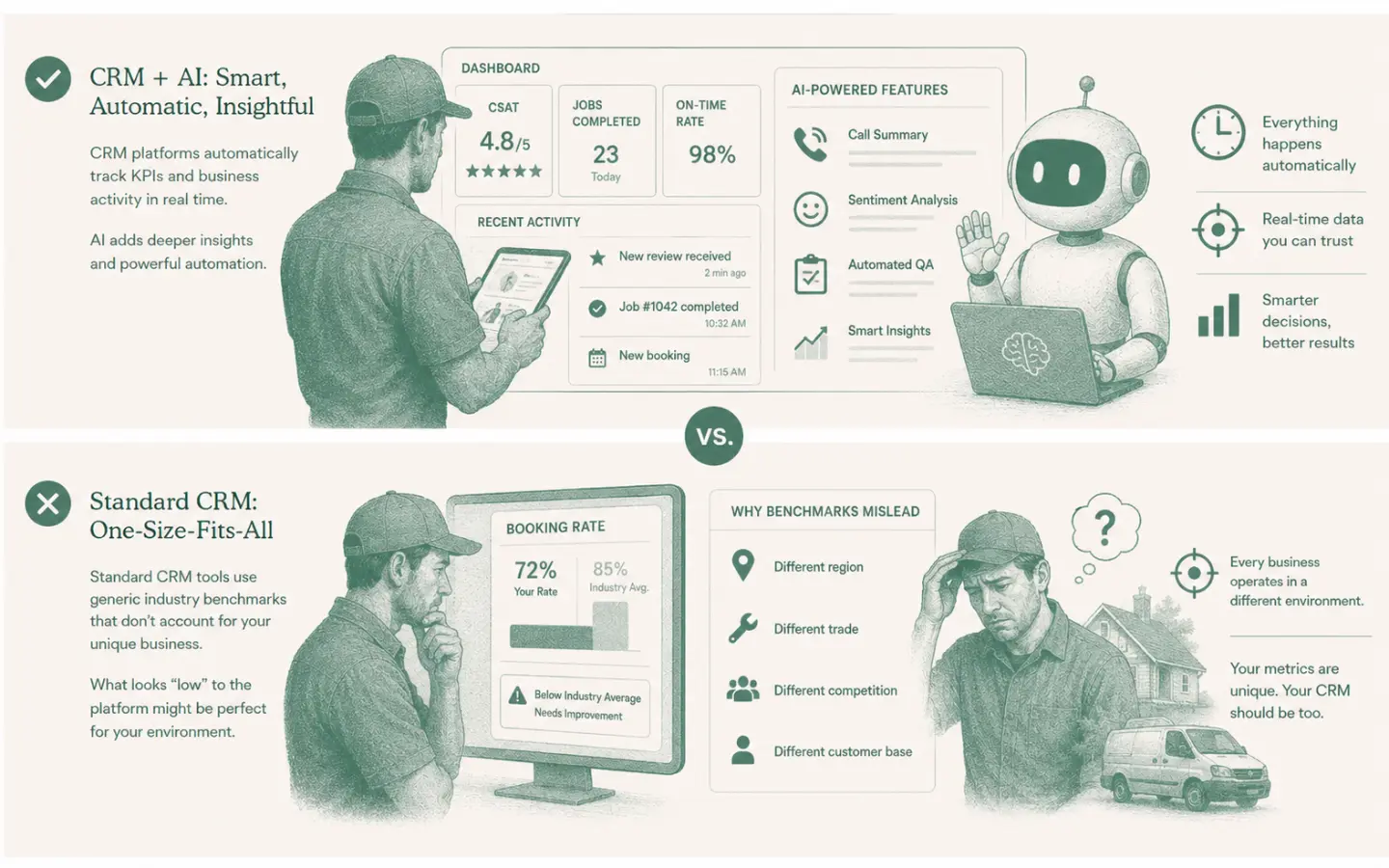
Your booking rate could be just perfect based on factors like your trade, region, competition, and existent customer base. Standard CRM platforms can’t account for these variables because they lack customization.
How Dalton Mills Helps You Track and Adjust Your KPIs in Real Time
Dalton Mills can help you track and adjust your KPIs in ways standard CRM platforms can’t. Customization is the real differentiator here.

With Dalton Mills, you no longer need to fit your business within a standard CRM software; instead, you can create your own CRM software, designed specifically for your business, your operations, and your environment.
This immediately solves one of the biggest problems in the CRM business today – lack of customization. Few businesses have all their needs met by their current CRM provider(s). It’s just that most of them simply try to work with what they have. In many cases, contractors can employ multiple CRM tools to track just as many metrics across their dashboard.
One such example is a restoration contractor who was using 11 different softwares before replacing them all with just one that he built himself. And his case is not singular.
Dalton Mills fills that gap and allows contractors like you to build their own CRM or field-service tools from scratch, designed to address problems unique to your business. No coding required, since our integrated AI is in charge of that.
Dalton Mills is currently in early access so, if you want to use our services, sign up for access today.
You can also use our free business management tools, designed to cover the 36 service trades that we currently support.
Build the tools your trade needs.
Dalton Mills gives people in the trades the opportunity to create custom workflows and software tools without any prior technical experience.
Apply For Early AccessRead next

How Much to Charge for Roofing Jobs in 2026
Industry data today shows that the average roofing business racks in a net profit of around 2.8%, which means around half of them are making less than that.
October 6, 2026

How Google Ads Work for Plumbing Businesses
Plumbers can and should use a variety of marketing strategies to increase their clientele and gain more market visibility.
October 5, 2026

How to Price Window Cleaning Services in 2026
A piece of industry data shows that around 64% of window cleaning services earn under $100K annually.
October 4, 2026