July 13, 2026
How AI Increases the Approval Rates of Insurance Quotes for Restoration Jobs
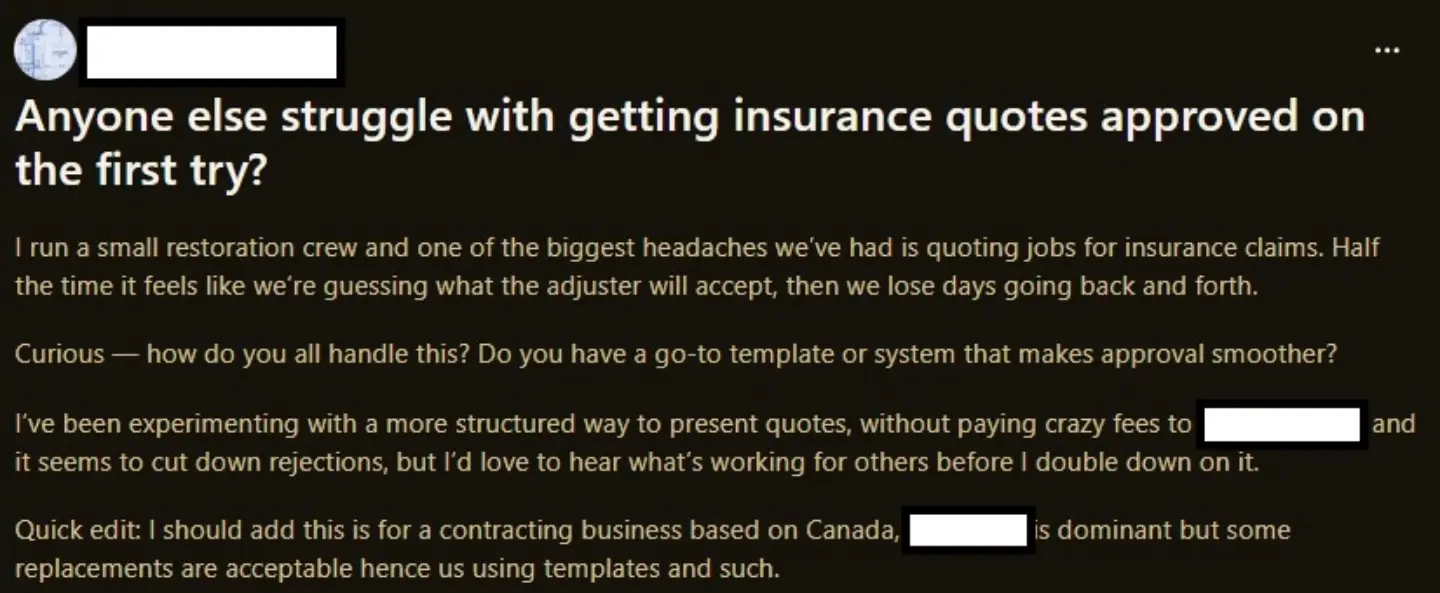
Most restoration businesses struggle with insurance quote delays and rejections due to the adjuster returning claims for revision.

Among the many problems experienced by restoration companies, having insurance providers delay payments, reject claims, change scopes, and manipulate the pricing is at the top of the list.
Moreover, this issue is widespread within the blue-collar space. Businesses like masonry, landscaping, pest control, roofing, and many others, face the exact same problems. The explanation is simple: the entire business model of insurance companies is centered around not paying insurance claims. Or negotiating the pricing to pay as little as possible.
This forces contractors to constantly resubmit claims, dispute prices, and undergo long waiting times for payments to go through.
In 2026, contractors can use AI to not only speed up the payment process, but also increase the claim acceptance rate.
Why Standard Service Software is Insufficient for Optimal Insurance Quoting
The most glaring problem with standard restoration software tools today is that they’re heavily reliant on the contractor’s personal assessment. These software tools cannot reason, cannot suggest changes, and cannot evaluate the quality of the estimate.
For reference, this is how the estimating process looks today from the perspective of a contractor using a standard software tool:
Inspect the property and record the damages (Photo + Video)
↓
Write the estimate
↓
Submit the claim
↓
The adjusters comes back requesting changes
↓
The contractor revises the claim file to make the changes
↓
Resubmit the claim
↓
Wait for approval
↓
If the adjuster is still not happy with the claim, redo the last 3 steps
This convoluted system then explains why only about 3% of restoration contractors receive their insurance payment within one or two weeks. The vast majority of them have to wait up to 8 weeks, while 18% of them go even beyond that.
AI works differently.
[CTA_INSERT]
How AI Speeds Up Insurance Claims for Restoration Jobs
The main advantage of AI over standard software is the fact that AI is a proactive tool; it doesn’t just record the estimate like standard estimating tools do.
Instead, the AI can review the estimate before submission to identify potential weak points that could cause the adjuster to ask for a revision. For instance, only providing 2 photos to record drywall damage, when similar previous claims with the same insurer included 6 or more photos.
The AI can also suggest modifications based on the insurer’s track record. An estimate that includes something like “Used 4 dehumidifiers for the kitchen over 4 days” may enter revision if the insurer only accepts 2-3 dehumidifiers for a kitchen of similar size.

Another insurer may only accept specific drying equipment charges if the claim also has moisture logs attached.
The AI will consider the insurers’ track record, learn from previous claims, and make sure that all claims are IICRC-compliant to lower the risk of revisions. This makes for cleaner insurance quotes, less delays, a lower risk of rejection, and faster payments.
Some insurance estimating software out there can also perform these tasks. The downside is that they often come with steep subscription plans and they’re third-party tools, designed for trades at large. You want an estimating tool designed specifically for your business and tailored to your unique needs.
Which explains why AI use is on the rise in the restoration trade, as well as in other service-rich trades like property maintenance, handyman services, and home cleaning.
How to Use AI for Insurance Quoting in Restoration Jobs
Contractors can use AI directly to review their insurance estimates. An even better option is to use AI to create a custom piece of software designed specifically for that, which is what most businesses do when it comes to integrating AI into their operations.
In one case, one professional restorator used AI to create a custom piece of software that he eventually used to replace 11 other standard software tools.
This is AI’s strongest point: the ability to help contractors build customized software, designed specifically for their business operations. By comparison, standard CRM and field service software are tailored to trades in general, not businesses in particular.
How to Build Custom Service Software for Restoration Work with Dalton Mills’s AI
Dalton Mills is a service platform designed specifically for blue-collar businesses that are dissatisfied with their current software tools. As an AI-driven service, Dalton Mills allows you to replace any software or service app you’re using with one that addresses problems unique to your business.
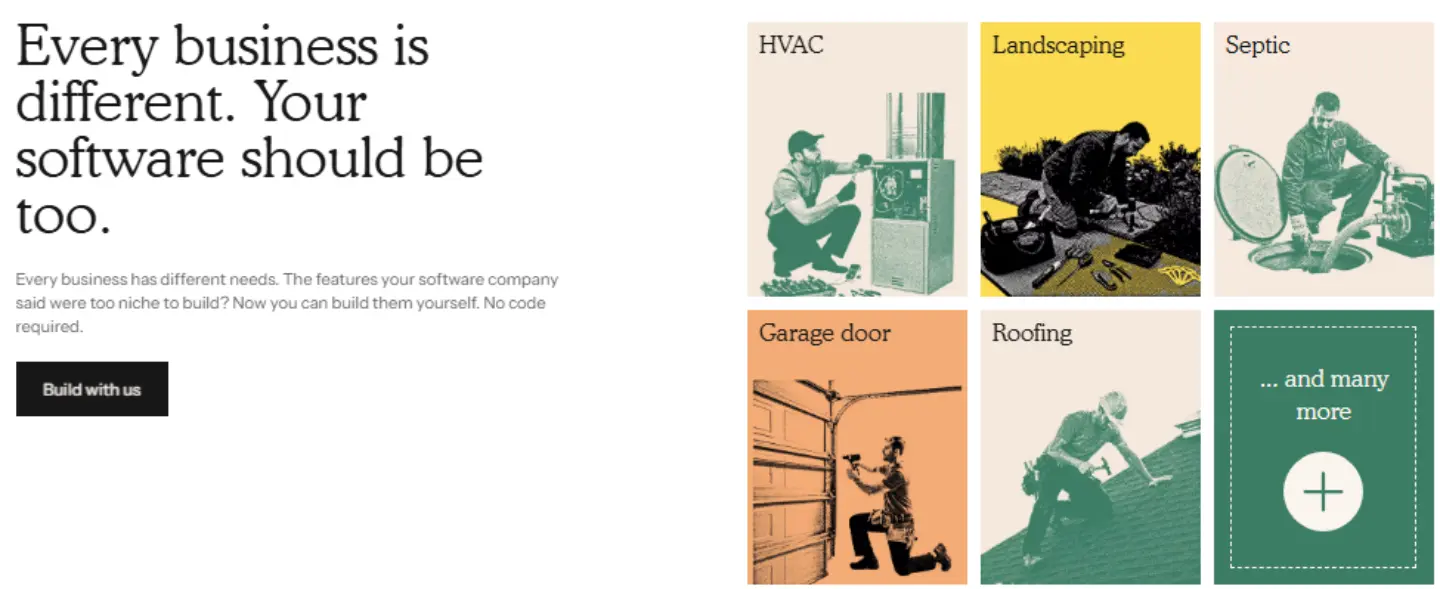
We’ve taken this approach because it’s impossible to predict all of the hurdles that one business may encounter in the market. No software developer can, which is why most, if not all, CRM and service software tools today come with a lot of blind spots. This sometimes forces contractors to resort to the tried-and-tested pen-and-paper to make up for it.
The Dalton Mills solution is to allow contractors to use their internal knowledge and operational experience to build their own tools instead. You know what you need, we help you build it.
There’s no coding necessary, since the entire process relies on you communicating with the AI openly, in a conversational manner. You explain the problem and the AI will provide potential solutions. Or, if you already know the software tool you need, the AI can build it for you.
You can try our services at Dalton Mills by going to the official page and applying for early access today.
Build the tools your trade needs.
Dalton Mills gives people in the trades the opportunity to create custom workflows and software tools without any prior technical experience.
Apply For Early AccessRead next

How Much to Charge for Roofing Jobs in 2026
Industry data today shows that the average roofing business racks in a net profit of around 2.8%, which means around half of them are making less than that.
October 6, 2026

How Google Ads Work for Plumbing Businesses
Plumbers can and should use a variety of marketing strategies to increase their clientele and gain more market visibility.
October 5, 2026

How to Price Window Cleaning Services in 2026
A piece of industry data shows that around 64% of window cleaning services earn under $100K annually.
October 4, 2026